What Does A Blackjack Dealer Have To Hit On
- What Does A Blackjack Dealer Have To Hit On
- What Does A Blackjack Dealer Have To Hit On The Road
- What Does A Blackjack Dealer Have To Hit On Slot Machines
- What Does A Blackjack Dealer Have To Hit On The Market
- What Do Blackjack Dealers Have To Hit On
- What Does A Blackjack Dealer Have To Hit One
- Does A Blackjack Dealer Have To Hit On 16
Hitting soft 17 gives the dealer the chance to make the 18, 19, 20 and 21 hands that can win on their own against a player pat hand. This comes into play most often when the dealer’s face up card is an Ace and basic strategy players hit until they have 17 or better. The house will win when players bust, regardless of the final dealer hand. In addition to these rules, when you play as the dealer you face additional rules that limit how you can hit or stand. In most casinos, the dealer is required to hit on hands worth less than 17 points, regardless of the cards that make up their hand. Hands worth 17 points, however, can’t be hit on. Regardless of what the dealer has up, you will always split, double down, or hit until you get at least a hard 12. If you are new at the game, you should learn how to play blackjack first. Start with your first two cards and check the list. Soft 13 (A,2) doubles against dealer 5 through 6, otherwise hit. Hard totals: A hard total is any hand that does not start with an ace in it, or it has been dealt an ace that can only be counted as 1 instead of 11. 17 and up always stands. 16 stands against dealer 2 through 6, otherwise hit. 15 stands against dealer 2 through 6, otherwise hit. The color of the cards does not have any effect. The goal of the game is to reach a score (=sum of the cards) as high as possible but not more than 21. A Blackjack (Ace and a card whose value is 10) beats all other combination of cards. If the final sum is higher than the sum of the dealer, the player gets a play-off of 1:1 of his initial stake.
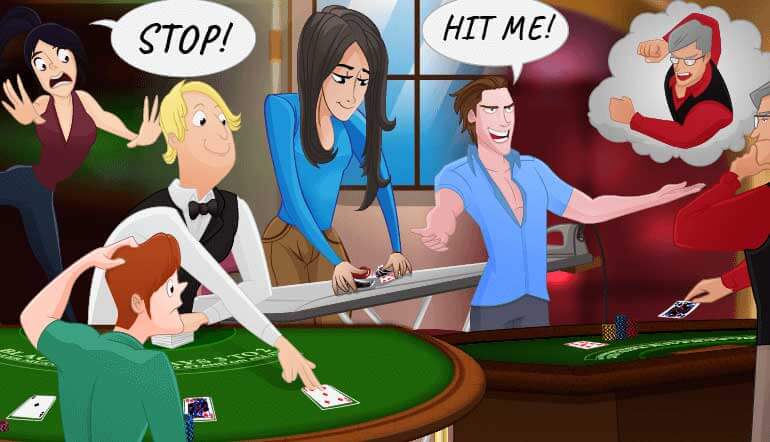
The entire game of blackjack is based around the two words “Hit me”. All of the strategy and logic in the game comes down to whether or not you want to get another card added on top of your first two cards. Remember, the goal of blackjack is to either make the dealer bust, hit 21 yourself, or have a higher number than the dealer ends up with.
Most of the variance in the game comes from the idea of hitting or standing when you either get another card dealt to you, at risk of busting, or stay where you are, and risk the dealer beating you. This is a complex decision making process, and it’s important to know how to approach it.
This page details all of the methods you can use to understand when to hit or stand, and at the end, you can find a chart explaining why. Let’s jump right into it with a discussion of the dealer’s up card and why that matters.
Knowing When To Hit Or Stand - The Dealer’s Up Card
Understanding the implications of the dealer’s up card is very important. Basically, you get to see one of the dealer’s cards, and that allows you to make some guesses as to what number they are at, and what their decision making process will be. The higher the dealer’s up card, the more likely the player is to want to hit, as a general rule. This is because, once again, the goal is to beat the dealer - to get the closest to 21 without going over. The card you see tells you a lot about the range of possibilities they could have. For example, if you see a 2, you know that their total is relatively low, and if you have a decent total, it could be correct to stand. That’s the basics of understanding a dealer’s up card, but there’s so much more to understand what the process is behind choosing to stand.
When To Stand In Blackjack
The basic idea of when you want to stand in blackjack is when you have a pretty good idea that your total is pretty close to 21, you don’t want to risk going over, and you want to put the onus on the dealer to beat your total. This tends to mean that you want to start seriously considering standing at around 17 total. The idea here is that, unless you can see an ace from the dealer, you’re fairly likely to have more than them at this point, given the amount of times cards that are worth more than 7 appear in the deck. If you have 19, you’re always standing, for example. You’re likely to bust if you hit, and it’s relatively hard to beat. The rules for this are fairly fluid so understand them well.
When To Hit In Blackjack
The basic idea behind when you want to hit in blackjack is twofold. First, you want to hit when you aren’t in much danger of going over or busting. Second, you want to hit when you need to beat a decent dealer total. This means that if you have a middling hand, let’s say 15, you’ll want to stand if the dealer’s face up card is fairly low, but hit if the dealer’s face up card is higher. This is because you can extrapolate the range of possible outcomes from the dealer’s face up card, and understand when you need to hit, and when you need to stand. There’s a lot of math that goes into this, but you can play by intuition as well. Remember, the goal of the game is to beat the dealer without going over - and that’s devilishly simple, but devilishly tricky as well.
When Does The Dealer Have To Hit In Blackjack
The basic rules that most dealers follow, across the board, are determined to their mathematical advantage over years of study and play. The dealer will always hit on anything below a 16 total. This is why, when you have a 17, you tend to consider staying - you have something fairly close to what they tend to stay at. This can get a little more complex when people start considering aces, which allow the concept of hard and soft 17s to enter the equation, but that’s mostly a discussion for a different page. Suffice to say, the basic rule they follow is that they will hit anything that is a 16 total or below.
When Does The Dealer Have To Stay In Blackjack
Dealers in blackjack follow strict rules - rules that are designed for them to play as optimally as possible against you. The basic idea behind most of them is to optimize their mathematical odds at victory. For this reason, almost all dealers will stand when their total is 17 or above. As before, aces throw a bit of a wrench into this equation, but there is a lot of grey area in Blackjack. The basic rule they follow is to stand on 17 because that puts the onus on you to beat a 17, which is pretty hard to do without going over.
Hit Or Stand Cheat Sheets
Here is a very basic legal blackjack hit or stand cheat sheet. Remember that the math changes depending on which type of blackjack you’re playing, so make sure you understand what’s going on in each variant you play.
| Your Hand | Up Card | |||||||||
| 2 | 3 | 4 | 5 | 6 | 7 | 8 | 9 | 10 | A | |
| <11 | Hit | Hit | Hit | Hit | Hit | Hit | Hit | Hit | Hit | Hit |
| 12 | Hit | Hit | Stand | Stand | Stand | Hit | Hit | Hit | Hit | Hit |
| 13 | Stand | Stand | Stand | Stand | Stand | Hit | Hit | Hit | Hit | Hit |
| 14 | Stand | Stand | Stand | Stand | Stand | Hit | Hit | Hit | Hit | Hit |
| 15 | Stand | Stand | Stand | Stand | Stand | Hit | Hit | Hit | Hit | Hit |
| 16 | Stand | Stand | Stand | Stand | Stand | Hit | Hit | Hit | Hit | Hit |
| 17-21 | Stand | Stand | Stand | Stand | Stand | Stand | Stand | Stand | Stand | Stand |
Blackjack is one of the very few casino-banked card games where the decisions players make have a direct impact on their long-term chances of winning and preserving their bankrolls. Whether you make the correct plays or not will ultimately determine whether you emerge as a long-term winner or loser.
When you join a blackjack table, the two most fundamental playing decisions you are facing are whether to hit or stand on your hand. Ironically, these two decisions rank last in the order of plays you can exercise at the blackjack table.
The reason for this is simple – unlike surrendering, splitting, and doubling, you can hit or stand on hands that comprise any number of cards whereas the other moves are possible only on two-card totals. Both plays are accompanied by specific hand gestures which differ depending on whether you join a shoe-dealt table or a pitch game.
The great thing about blackjack is that the game combines elements of luck, skill, and strategy. There is no need to rely on gut feelings in order to make the correct move. All you have to do is memorize basic blackjack strategy. It gives you the foundation of becoming a successful blackjack player by telling you when to hit your hand and when to stand.
Hitting a Hand in Blackjack
A new round at the blackjack table starts with everyone receiving two cards that comprise their starting hands. This includes the dealer who normally receives their first card up while their second card is dealt face-down. The players would either receive their two cards face-up in shoe-dealt blackjack or face-down in pitch games where only one or two decks are in play.
At this point, each player takes a good look at their initial two-card hand, checks the dealer’s exposed card, and decides whether to take a hit or not. Hitting is the first most common decision one makes at the blackjack table. It involves the player requesting additional cards on their initial hand.
What Does A Blackjack Dealer Have To Hit On
In multiple-deck games dealt out of a shoe, the player indicates they want to hit either with a beckoning gesture with their finger or by tapping the felt next to their two cards. In pitch games where you receive your cards face down, a hit is indicated by lightly scraping the felt with your two cards.
Players are allowed to take as many hits as they like unless the last card drawn to their hand causes it to break, i.e. go over 21. You can hit any total, with the exception of pat blackjacks which automatically stand.
The main reason for drawing additional cards is to try and improve the value of your hand. Your hitting decisions are influenced by two factors – the current total of your hand and the upcard the dealer is showing.
Standing on a Hand in Blackjack
Standing on a hand is practically the opposite of hitting. The player is satisfied with their current hand value and declines additional cards from the dealer. Similarly to hitting, this decision must be designated with a physical gesture for the purpose of hindering cheaters and preventing misunderstandings on behalf of the dealer and surveillance.
This physical motion involves waving your palm horizontally over your two cards in shoe-dealt games. The gesture is different in single-deck and double-deck games where standing is indicated by sliding the corners of your cards under the chips you have originally placed in your betting box.
Forced Standing Rules for Dealers and Their Variations
Unlike blackjack players, the house representative who deals the cards does not make any decisions when playing out their hand. Instead, blackjack dealers draw cards or stand on their hands according to the forced rules specified by the gambling establishments.

These forced dealer rules vary depending on the gambling hall and the blackjack table you play at, but are generally classified into two main groups. The dealer is either required to draw to 16 and force-stand on all totals of 17 or must draw to 16, stand on hard 17 and hit soft 17. The dealer standing rule is printed on the layout, which makes it easy for players to distinguish what table they are playing.
Which of the two dealer rules is better from the perspective of the player, though? To answer this question, we must first explain what a soft 17 is. This is a hand that contains an Ace whose value is flexible, i.e. it can be either 1 or 11, like in the following two examples – A-6 and A-2-4. Due to the fluctuating value of the Ace, one such soft hand practically has two totals, 7 and 17.
The dealer forced standing rules should be always taken into consideration because they have a direct impact on basic strategy as well as on the house edge. A total of 17 is not strong enough in blackjack where the average winning hand totals 18.5. A dealer who hits soft 17 is less susceptible to exceeding 21 and thus, losing because of the flexible value of the Ace.
If a higher-ranking card is drawn, the dealer’s Ace will count as 1. This practically makes it impossible for them to bust by taking one more card. However, if they happen to catch a small card like a deuce on the next hit, it gets them into the safe zone and they can outdraw the player, who always stands on hard 17 according to basic strategy.
A dealer who hits soft 17 (H17) increases the house edge by 0.22%. This may seem like a small increase in the casino’s advantage but nevertheless, it leads to higher hourly losses in the long term for the basic strategy player.
Assuming you play at a full table where you flat bet at the minimum of $5 and go through 60 hands per hour on average, you will lose roughly ($5 x 60 x 0.22)/100 = $0.66 per hour due to the soft 17 rule alone.
Of course, these figures apply only over the long run where thousands of hands are involved. Nevertheless, a smart blackjack player always favors tables where the dealer stands on all 17 over those where they hit soft 17.
Key Basic Strategy Plays for Hitting and Standing
Basic strategy tells blackjack players when it is the correct time to hit and when they should stand, among other things. The decision is based on the upcard of the dealer and the player’s hand total. Basic strategy is proven to reduce the house edge, but some of the hitting and standing decisions it suggests also aim at minimizing the long-term losses players incur in unfavorable situations. With that said, you cannot overcome the house edge entirely with basic strategy alone.
The correct plays are influenced by a variety of factors which include the above-mentioned dealer forced rules, the number of decks incorporated into the game, and the possible rule variations at different blackjack tables.
The strategy is normally presented in a table format. Here are several of the most important standing and hitting decisions recommended by basic strategy for multiple-deck games where the dealer force-stands on all 17s:
- Always hit totals 4 through 8 regardless of what card the dealer shows
- Stand on hard totals of 12 if the dealer exposes small cards 4 through 6 and hit your hard 12 against all other dealer cards
- Hit 16 against a dealer with a ten-value card or Ace, otherwise surrender if allowed
- Always hit soft totals 13 through 17 and stand on soft 19
- Stand on soft totals of 18 unless the dealer is showing high cards like 9, 10, and Ace. If so, hit your soft 18.
- Stand on all hard totals of 17 or higher
What Does A Blackjack Dealer Have To Hit On The Road
Deviations from Basic-Strategy Hitting and Standing Decisions
Learning basic strategy is an absolute must for anyone who insists on becoming a winning blackjack player. With that said, basic strategy relies on limited information. It tells you the optimal plays you can make in any given situation after you have received your first two cards and have seen the dealer’s exposed card.
However, it does not take into account the way the composition of the deck or shoe changes as more and more cards are removed from play. These changes in composition are important because they have a direct impact on the house edge.
If more ten-value cards and Aces remain to be dealt, the edge swings over in favor of the player and vice versa, the dealer has an advantage when the remaining shoe or deck is richer in small cards. Smart players have learned to exploit this peculiarity of the game by keeping track of the ratio of high to low cards that remain to be dealt.
This is known as card counting. The player keeps a running count as each card is dealt out of the shoe and then converts it into a true count. This conversion is necessary for shoe games and involves the division of the current running count by the number of decks that remain in play.
A high positive true count indicates the shoe is rich in high cards and vice versa, a negative true count means more small cards are still in play. Using this information, well-versed players would deviate from basic strategy for certain hitting and standing decisions. The plays suggested by the strategy are based on a neutral deck or shoe and are no longer optimal after the composition changes.

A Couple of Examples for Hitting and Standing Deviations
What Does A Blackjack Dealer Have To Hit On Slot Machines
Blackjack pros resort to using indices for their playing deviations. An index is a number that tells you at what true count you must diverge from the basic strategy. Let’s use hard 12 against a dealer with a deuce as an example just to give you a better idea of how playing deviations for hitting and standing work.
What Does A Blackjack Dealer Have To Hit On The Market
A basic strategy chart for multiple-deck games under the S17 rule recommends you to hit your 12 against a 2. However, this play is no longer optimal once you arrive at a true count of +3. Now, there are more tens and face cards you can bust with. Therefore, you must deviate from basic strategy and stand on your 12 against the 2 when the true count is +3 or higher.
Another example is a hand of hard 16 against a dealer with a 9 as their upcard. According to basic strategy, you must hit your hard 16 against the 9 if surrender is unavailable. Unfortunately, this decision is a bad one on high positive counts of +5 or above. Respectively, the player stands (the pun was unintentional) better chances of winning if they refrain from drawing more cards because hitting is more likely to break their 16 in shoes that are rich in tens.
And one final example with a hard 13 versus a dealer showing a 3, in which case you should stand according to basic strategy. This may be a good idea in a neutral shoe but it becomes unprofitable on negative counts.
What Do Blackjack Dealers Have To Hit On
The index for this hand is -2, which is to say you deviate from basic strategy when the true count drops to -2 or lower by choosing to hit instead of standing. At this point, there are more small cards than high cards to help you improve your hand and minimize the risk of breaking it.
What Does A Blackjack Dealer Have To Hit One
Playing deviations are great not only for hitting and standing but for all other possible moves in blackjack, like doubling, splitting, surrendering, and buying insurance. Not only do these deviations enable the player to generate more EV in the long term but they also reduce risk and help you tame variance.
Does A Blackjack Dealer Have To Hit On 16
With that said, it is impossible to use them without committing basic strategy to memory first, so we suggest this is where you start if you take your blackjack game seriously.