What's A Draw In Poker
A royal flush is the highest straight of cards, all in one suit: 10-J-Q-K-A. This hand is very tough to make. Being dealt this hand in five-card stud poker will happen about once in every 649,000 hands. In five card draw (or video poker), it will happen about once in every 40,000 hands. For the main poker variations - Texas Hold'em, Pot-Limit Omaha, Seven-Card Stud, 5-Card Draw - hand rankings are the same. But for split games - Omaha Hi-Lo, Stud Hi-Lo - half of the pot is awarded to the lowest hand. For lowball games like 2-7 Triple Draw and Razz only the lowest hand will win the pot. Some readers may wonder why one would ever need to compare (say) two threes of a kind of equal rank. This obviously cannot arise in basic draw poker, but such comparisons are needed in poker games using shared (community) cards, such as Texas Hold'em, in poker games with wild cards, and in other card games using poker combinations.
Introduction
Lowball or Low Poker is poker in which the lowest ranking hand wins. Most poker variants can be reversed in this way, but the name 'Lowball' is most often used to refer to a low version of Five Card Draw Poker. On this page several versions of this game are described. They differ in the hand ranking, the drawing procedure and whether a wild card is used, and these are described on this page.
The different possible rankings for low poker are explained on the hand ranking page. The differences depend on whether Aces are counted as high or low, and whether straights and flushes count. Paired cards always count, so in the absence of straights and flushes a hand of five different ranks always beats a hand containing any duplicate ranks.
When drawing to a five-card hand to make a low hand, it is seldom worth drawing more than one card. If you draw two cards you will make a pair about half the time, and however low the three cards are that you keep, your chance of getting a 9-high or better is never more than 25%. For this reason, there are versions of lowball in which players have more than one opportunity to draw. In such a game you can afford to draw more than one card the first time, but if you stay for the last draw you will either stand pat or draw just one card, hoping for a low card that does not pair with any of your other four.
Although Draw Poker is perhaps the most usual form of Lowball game, the Lowball version of Five Card Stud also works well, and Seven Card Stud Low is also played under the name Razz. The name Lowball is also occasionally used to refer to the game called Jacks Back on this site, which begins as Five Card Draw Jacks or Better and is played for low if no one has a good enough hand to open.
California Lowball
Also known as Ace-to-Five Single Draw, this game is similar to Five Card Draw Poker, but in the showdown the lowest hand wins, using ace-to-five ranking. That is, aces are always low and straights and flushes do not count, so the lowest hand is A-2-3-4-5, then A-2-3-4-6, A-2-3-5-6, etc. AS always the highest cards of an unpaired hand are compared first, so for example 7-5-4-3-2 beats 7-6-3-2-A.
It is possible to play with an ante, but in formal games it is more often played with blinds. The dealer places a small blind and the next two players to the left of the dealer each place a big blind equal to the minimum bet.
Everyone is dealt five cards and there is a round of betting. If an ante is used this begins with the player to the left of the dealer. When blinds are placed, these count as bets and the first betting round begins with the player immediately to the left of the blinds; the players who placed big blinds are allowed to raise when the turn comes around to them even if no one else has done more than call.
After the first betting round, surviving players in turn, starting to the dealer's left, can discard any number of cards (in practice seldom more than one card) and are dealt replacements. There is then a second round of betting. If the game is played with blinds this is started by the first active player to dealer's left. If there are antes and no blinds, the second round is begun by the player who opened the first round of betting.
When Lowball is played as a fixed limit game, some play that the size of the bet is doubled after the draw and others play that it remains the same.
This game is often played with a joker added to the deck. The joker, sometimes known as the fitter, represents the lowest rank not present in the holder's hand. For example 8-6-4-A-joker is equivalent to 8-6-4-2-A.
Betting Sevens
Some play that a player who checks after the draw with a hand that is 7-low or better (five different ranks with nothing higher than a 7) and has the best hand at the showdown can only win the chips that were in the pot at the time of the draw. Any chips that were bet after the draw are placed in a separate pot that this player is not eligible to win.
Betting, calling a bet or raising after the draw entitles you to win the whole pot with your 7-low or better if you have the best hand at the showdown, provided that you did not check at your first turn to act after the draw. It is therefore unwise to check after the draw with such a hand, unless you intend to fold if another player bets against you.
Kansas City Lowball
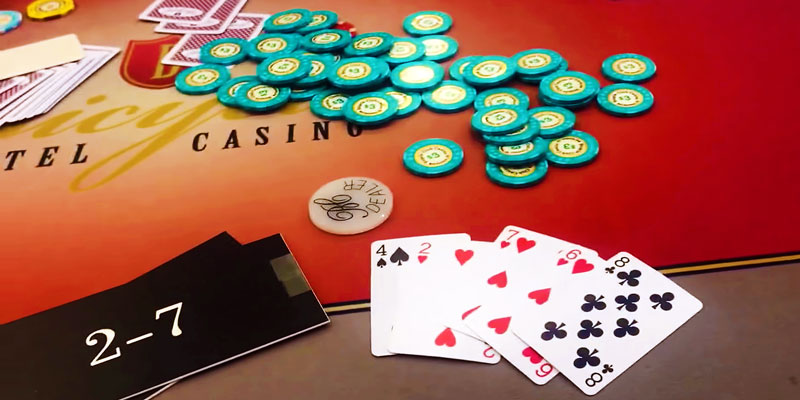
Kansas City Lowball is also called Deuce to Seven Single Draw or sometimes Billy Baxter Lowball after the player who won the world championship in this game several times. In this game, Aces are always high and straights and flushes do count (and are therefore bad), but A-2-3-4-5 is not a straight, because the Ace is high. The best hand possible is 7-5-4-3-2 (hence 'Deuceto Seven'), followed by 7-6-4-3-2, ... K-Q-J-10-8, A-5-4-3-2, A-6-4-3-2, ... up to the usual royal flush, which is worst. In other words, it's the exact opposite of normal high poker except for the A-2-3-4-5 rule.
The deal, draw and betting are similar to California Lowball. So far as I know, this game is normally played without a joker, and there is no equivalent of the 'betting sevens' rule.
The Deuce to Seven page of the Play Lowball Poker site has further information on this game.
Ace-to-Six Lowball
This is Five Card Draw Poker using ace-to-six ranking, in which straights and flushes count but aces can be low. Normally A-A should be the lowest (and therefore best) pair, but A-K-Q-J-10 would count as a straight - but opinions may differ, so these details should be agreed in advance among the players.
This game is often ignored or said to be unusual in books and on poker web sites. This may be because it is not played in public card rooms on the American West Coast and rarely offered as an online game. However, I suspect it is fairly widespread in home poker games, particularly on the American East Coast and in Europe.
Triple Draw
In this game players have three opportunities to improve their hand. According to some sources the maximum number of players for this game is six. Certainly with a larger number of players the cards will frequently run out and discards will need to be recycled.
Normally it is played with blinds: the player to dealer's left posts a small blind, and the next player to the left posts a big blind, equal to the mimimum bet for the game.
The dealer deals five cards to each player and there is a round of betting beginning to the left of the big blind. As usual in games with blinds, the big blind player is allowed to raise even if the others have all folded or called. Then in clockwise order, starting to dealer's left, players may discard any number of cards and are dealt replacements. There is a second round of betting begun by the first active player to dealer's left. This is followed by a second opportunity to discard and draw, a third round of betting, a third discard and draw, and a fourth round of betting. In a fixed limit game, the size of the bet is normally doubles after the second draw, so that the last two rounds have big bets.
It happens fairly often in this game that the dealer runs out of cards. In this case all the discarded cards (the 'muck') are shuffled and cut to form a new deck from which replacement cards are dealt to players who are still waiting to draw.
There are two versions of this game, depending on the hand ranking used in the showdown (see low poker hand ranking):
- Deuce to Seven Triple Draw, which uses deuce-to-seven ranking, is perhaps the more popular game.
- Ace to Five Triple Draw, using ace to five ranking is also sometimes played.
The Triple Draw page of the Play Lowball Poker site has further information on the history and variants of this game.
Double Draw
This game is similar to Triple Draw, except that players only have two opportunities to improve their hands by drawing cards. There are therefore three betting rounds: after the deal, after the first draw and after the second draw. Either ace-to-five or deuce-to-seven (or even ace-to-six) ranking can be used, as agreed by the players.
Five-card draw (also known as a Cantrell draw) is a pokervariant that is considered the simplest variant of poker, and is the basis for video poker. As a result, it is often the first variant learned by new players. It is commonly played in home games but rarely played in casino and tournament play. The variant is also offered by some online venues, although it is not as popular as other variants such as seven-card stud and Texas hold 'em.
Gameplay[edit]
In casino play the first betting round begins with the player to the left of the big blind, and subsequent rounds begin with the player to the dealer's left. Home games typically use an ante; the first betting round begins with the player to the dealer's left, and the second round begins with the player who opened the first round.
Play begins with each player being dealt five cards, one at a time, all face down. The remaining deck is placed aside, often protected by placing a chip or other marker on it. Players pick up the cards and hold them in their hands, being careful to keep them concealed from the other players, then a round of betting occurs.
If more than one player remains after the first round, the 'draw' phase begins. Each player specifies how many of their cards they wish to replace and discards them. The deck is retrieved, and each player is dealt in turn from the deck the same number of cards they discarded so that each player again has five cards.
A second 'after the draw' betting round occurs beginning with the player to the dealer's left or else beginning with the player who opened the first round (the latter is common when antes are used instead of blinds). This is followed by a showdown, if more than one player remains, in which the player with the best hand wins the pot.
House rules[edit]
A common 'house rule' in some places is that a player may not replace more than three cards, unless they draw four cards while keeping an ace (or wild card). This rule is useful for low-stakes social games where many players will stay for the draw, and will help avoid depletion of the deck. In more serious games such as those played in casinos it is unnecessary and generally not used. However, a rule used by many casinos is that a player is not allowed to draw five consecutive cards from the deck. In this case, if a player wishes to replace all five of their cards, that player is given four of them in turn, the other players are given their draws, and then the dealer returns to that player to give the fifth replacement card; if no other player draws it is necessary to deal a burn card first.
Another common house rule is that the bottom card of the deck is never given as a replacement, to avoid the possibility of someone who might have seen it during the deal using that information. If the deck is depleted during the draw before all players have received their replacements, the last players can receive cards chosen randomly from among those discarded by previous players. For example, if the last player to draw wants three replacements but there are only two cards remaining in the deck, the dealer gives the player the one top card he can give, then shuffles together the bottom card of the deck, the burn card, and the earlier players' discards (but not the player's own discards), and finally deals two more replacements to the last player.
Sample deal[edit]
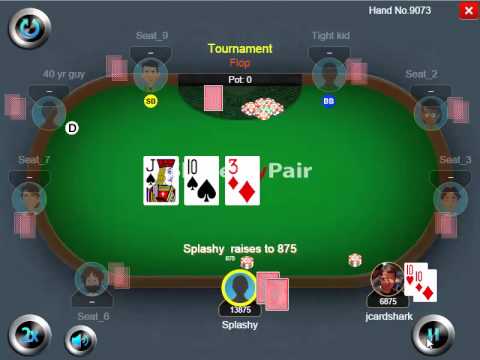
The sample deal is being played by four players as shown to the right with Alice dealing. All four players ante $1. Alice deals five cards to each player and places the deck aside.
Bob opens the betting round by betting $5. Carol folds, David calls, and Alice calls, closing the betting round.
What Is A Straight Draw In Poker
_and_Carrier_Air_Wing_(CVW)_3_compete_in_a_Texas_Hold_ "Straight")
Bob now declares that he wishes to replace three of his cards, so he removes those three cards from his hand and discards them. Alice retrieves the deck, deals a burn card, then deals three cards directly to Bob, who puts them in his hand. David discards one card, and Alice deals one card to him from the deck. Alice now discards three of her own cards, and replaces them with three from the top of the deck (Note: in a player-dealt casino game there is often a rule that the dealer must discard before picking up the deck, but this is a home game so we won't worry about such details).
Now a second betting round begins. Bob checks, David checks, Alice bets $10, Bob folds, David raises $16, and Alice calls, ending the second betting round and going directly into a showdown. David shows a flush, and Alice shows two pair, so David takes the pot.
Stripped deck variant[edit]
Five-card draw is sometimes played with a stripped deck. This variant is commonly known as 'seven-to-ace' or 'ace-to-seven' (abbreviated as A-7 or 7-A). It can be played by up to five players. When four or fewer players play, a normal 32-card deck without jokers, with ranks ranging from ace to seven, is used. With five players, the sixes are added to make a 36-card deck. The deck thus contains only eight or nine different card ranks, compared to 13 in a standard deck. This affects the probabilities of making specific hands, so a flush ranks above a full house and below four of a kind. Many smaller online poker rooms, such as Boss Media, spread the variant, although it is unheard of in land casinos.
Maths of Five-card draw[edit]
- Pre-draw odds of getting each hand
What Is Single Draw In Poker
- Royal flush <0.001%
- Straight flush (not including royal flush) <0.002%
- Four of a kind 0.02%
- Full house 0.14%
- Flush (excluding royal flush and straight flush) 0.20%
- Straight (excluding royal flush and straight flush) 0.39%
- Three of a kind 2.11%
- Two pair 4.75%
- One pair 42.30%
- No pair / High card 50.10%